Evidence paper · Version 0.1

The Victorian Carpenter Occupational Progression Gap

Victoria recognises the foundational carpenter qualification and the wider responsibilities of registered builders. What is not clearly recognised is the higher-level carpenter who has independently demonstrated advanced residential renovation competence. This progression gap is treated as one indicator for investigation, not as proof that a new registration category is required.

Understanding the roles

The professional distinction

Advanced carpentry competence

  • Existing-building diagnosis
  • Concealed-condition recognition
  • Renovation sequencing
  • Temporary support awareness
  • Advanced trade execution
  • Evidence capture
  • Scope escalation judgement

Domestic builder authority and responsibility

  • Contracting responsibility
  • Project coordination
  • Multi-trade management
  • Statutory obligations
  • Permit and insurance responsibilities
  • Broader commercial and consumer duties

"These capabilities may overlap, but they are not interchangeable and should not be treated as a single progression outcome."

Pathway comparison

Progression evidence as an indicator for policy investigation

The occupational progression gap helps explain why the practitioner-function question warrants investigation. It does not, by itself, establish the case for regulatory intervention or any particular statutory mechanism.

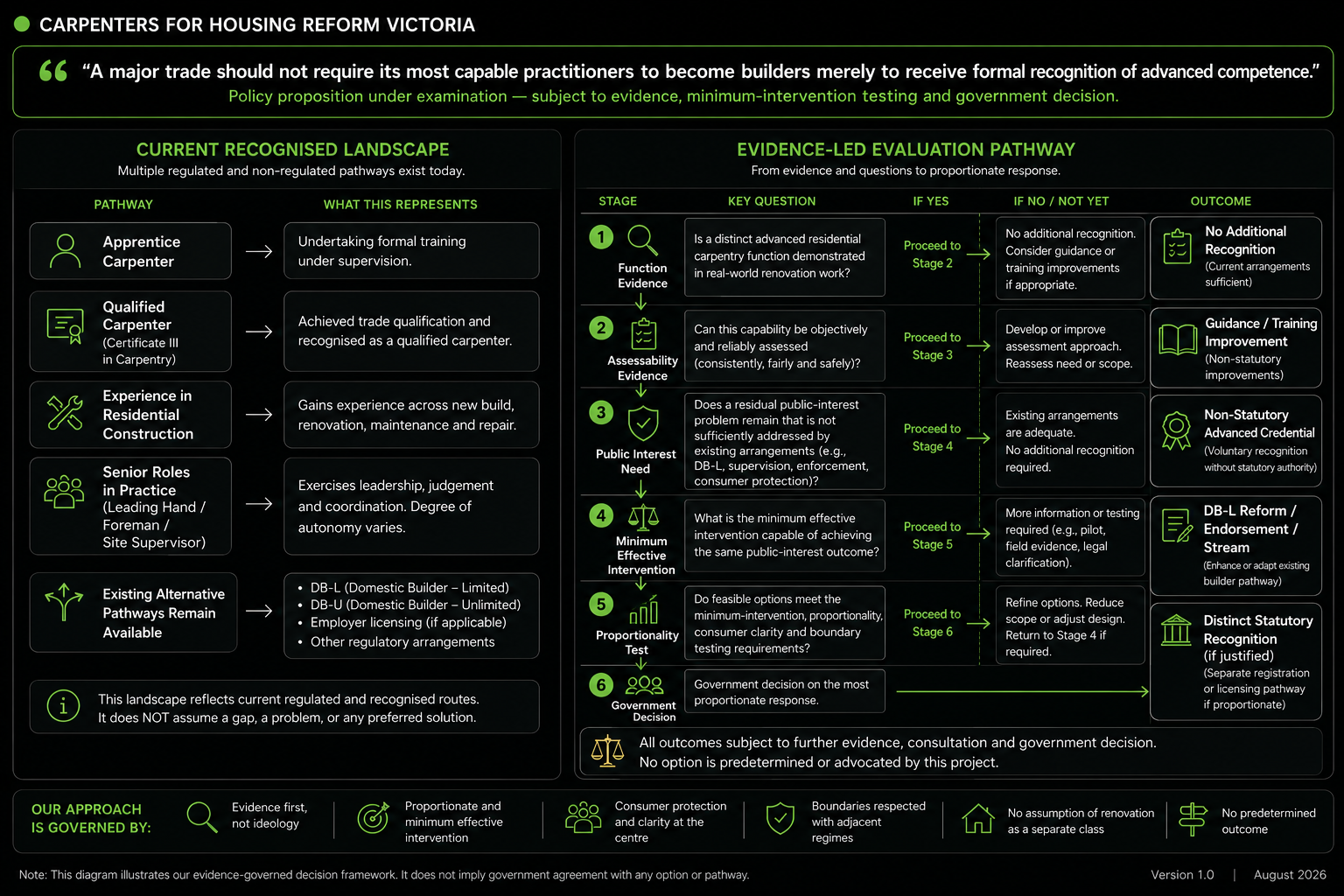
"A major trade should not require its most capable practitioners to become builders merely to receive formal recognition of advanced competence."

Current pathway
Apprentice Carpenter
Qualified Carpenter
Experience without formal advanced recognition
Remain a carpenter or pursue builder registration
Proposed progression
Apprentice Carpenter
Qualified Carpenter
Advanced Residential Carpenter — independently assessed

Recognition / implementation mechanism

Subject to evidence and government evaluation. Options include RRC, DB-L Carpentry reform or endorsement, a non-statutory advanced credential, another proportionate mechanism, or no new formal recognition.

Optional Domestic Builder Pathway

DB-L or DB-U, subject to existing registration, assessment and legal requirements.

Foundational qualification

What Certificate III establishes

Certificate III in Carpentry is the essential trade foundation. It establishes substantial practical competence and contains individual competencies relevant to demolition, repair and alteration work. It should not, however, be treated as proof that every graduate has been independently assessed in advanced existing-home renovation practice.

Foundational trade competence

Certificate III establishes core carpentry skills across new and existing construction contexts.

Renovation-relevant individual units

The qualification includes individual competencies relevant to demolition, repair and alteration work.

Variable workplace exposure

Workplace experience during apprenticeship varies significantly. Graduates may have limited exposure to complex existing-building renovation environments.

No dedicated advanced renovation designation

Certificate III does not carry a specific designation recognising independently assessed advanced residential renovation competence.

Competence and recognition

Experience is evidence, not automatic entitlement

Years create eligibility, not registration

Duration of experience establishes eligibility to be assessed. It does not by itself demonstrate the required competence standard.

Breadth of work matters

The type, complexity and diversity of renovation work undertaken is relevant to the assessment of advanced capability.

Evidence must be independently verified

Claims of advanced competence require independent verification through documented assessment, not self-declaration alone.

Competence includes knowing when to stop and escalate

Demonstrated ability to recognise the limits of scope and appropriately engage builders, engineers and specialists is itself a component of advanced competence.

Practitioner evidence

Practitioner evidence cases

The following case summaries are drawn from practitioner experience. They illustrate the type of existing-building judgement required in advanced residential renovation work. They are presented as practitioner evidence, not verified regulatory findings.

Case 1: Severe subfloor decay — "piano floor"

Original apparent scope: Localised flooring repair.

Discovery: Extensive concealed decay, failed ventilation and structurally compromised floor framing.

Decision: Expand investigation to sound structural boundaries and rebuild rather than patch.

Capability demonstrated: Hidden-condition diagnosis, structural risk recognition and scope reassessment.

Case 2: Major termite rectification

Original apparent scope: Localised termite or external-wall repair.

Discovery: Progressive concealed damage extending through adjoining structural areas.

Decision: Stage investigation and reconstruction while determining the real damage boundary.

Capability demonstrated: Termite warning-sign recognition, sequencing, temporary stability awareness and escalation.

Case 3: Bathroom hidden-condition escalation

Original apparent scope: Standard bathroom renovation.

Discovery: Rot, damaged floor or wall substrates, unsafe services and unsuitable wet-area conditions.

Decision: Stop finishes, rectify structure, engage relevant trades and revise the sequence.

Capability demonstrated: Wet-area substrate assessment, multi-trade coordination and consumer scope communication.

Case 4: Speech-pathology conversion

Original apparent scope: Internal fit-out based on supplied plans.

Discovery: Undocumented walls, bricked-up construction and a concealed chimney conflicting with the planned stair.

Decision: Stop the planned sequence, investigate and redesign the work path.

Capability demonstrated: Existing-building interpretation, adaptive planning and professional coordination.

Case 5: Cladding and asbestos escalation

Original apparent scope: Replace ageing cladding.

Discovery: Asbestos, missing insulation, deteriorated framing and unsuitable substrates.

Decision: Escalate hazardous-material removal, repair the envelope and revise scope before installing new cladding.

Capability demonstrated: Hazard recognition, specialist handoff and building-envelope sequencing.
Recognition criteria

Proposed advanced assessment

The following entry criteria are proposed as the basis for advanced assessment. Final criteria would require government, regulatory and legal development.

Certificate III or recognised equivalent

Demonstrated foundational carpentry trade qualification or formally recognised equivalent.

Verified experience from commencement of apprenticeship

Evidence of time in the trade from the start of apprenticeship, verified by independent means.

Renovation project portfolio

A documented portfolio demonstrating a range of residential renovation projects, including complex existing-building environments.

Technical and diagnostic assessment

Independent assessment of technical competence and diagnostic capability in existing-building renovation contexts.

Legal-boundary knowledge

Demonstrated understanding of the practitioner's legal scope, mandatory escalation points and the responsibilities of builders, engineers and licensed trades.

Documentation and consumer communication

Demonstrated ability to document scope, record discoveries and communicate clearly with consumers about changes in scope or risk.

Demonstrated escalation

Evidence of appropriate escalation to builders, engineers, building surveyors or specialist trades in prior work.

Continuing professional development

Future mature-model principle if formal recognition is adopted on an ongoing basis, covering technical knowledge, regulation changes, evidence and consumer protection obligations.

Audit and complaints oversight

Acceptance of audit, complaints and oversight mechanisms as a condition of recognition.

Policy options

Relationship with builder registration

The evidence paper does not presume that a completely new statutory category is the only solution. Government should first assess the capability level itself and then examine whether it is best implemented through RRC, DB-L Carpentry reform, an advanced credential or another proportionate mechanism.

Advanced carpentry recognition and domestic builder registration serve different but overlapping purposes.

Advanced Residential Carpenter — independently assessed is the capability level. Registered Residential Carpenter is one proposed recognition pathway for that capability. DB-L and DB-U registration remain separate options for practitioners seeking the contracting authority and broader responsibility attached to domestic builder registration.

A carpenter could pursue either pathway according to their intended role. Advanced carpentry recognition would not replace, guarantee or become a prerequisite for DB-L or DB-U registration.

The final statutory mechanism for advanced carpentry recognition remains unresolved. Advanced assessment does not automatically grant builder authority, and domestic builder registration continues to be governed by existing legislative requirements.

The progression gap therefore supports investigation of the practitioner-function question. It is not treated as conclusive evidence that government should create a new class.

Questions for government

Government questions

These questions are presented for government and regulatory consideration. They are not rhetorical. Each reflects a genuine regulatory question requiring analysis.

Does Victoria recognise any higher occupational level within carpentry after Certificate III?

Is domestic builder registration intended to function as advanced carpenter recognition?

Does current DB-L Carpentry assessment distinguish renovation competence from new-build competence?

Could a renovation-specific stream, endorsement or revised assessment be attached to an existing registration framework such as DB-L Carpentry?

How should qualified carpenter identity be preserved while maintaining builder, engineering and specialist boundaries?

Should advanced renovation-carpentry recognition operate through RRC, DB-L reform, an advanced credential or another proportionate mechanism after the capability question is tested?

From evidence to government decision

The evidence paper defines the potential occupational gap. The Government Decision Pathway explains how that gap can be tested without committing prematurely to a permanent registration model.

Document status

Evidence status

Version 0.1 is an evidence-development paper. Verified findings, supported interpretations and unresolved regulatory questions are distinguished. The paper will be updated as primary evidence, regulator clarification and stakeholder feedback are received.