The problem
Victoria's current consultation must clarify what the proposed carpenter registration and licensing arrangements may recognise and require, and how the arrangements ultimately adopted may interface with domestic builder responsibility.
An evidence-led reform initiative for Victoria: clearer implementation of carpenter registration and licensing, clearer public guidance, and clearer handoff points between carpentry work and domestic builder responsibility.
Victoria is consulting on carpenter registration and licensing reform. This initiative examines what the resulting baseline arrangements may recognise, require and authorise, how existing competence may transition into them, and whether any additional capability question remains once those arrangements are clearer.
The immediate regulatory question is what the proposed carpenter registration and licensing arrangements may recognise, require and authorise. Only once the baseline arrangements are clearer should government test whether any materially different additional carpentry capability remains and whether any further recognition would serve the public interest.
Registered Residential Carpenter remains a developed candidate implementation model, not the predetermined outcome. Possible later mechanisms could include RRC, DB-L reform, an endorsement, an advanced credential, another government-selected mechanism, or no additional formal recognition.
Victoria's current consultation must clarify what the proposed carpenter registration and licensing arrangements may recognise and require, and how the arrangements ultimately adopted may interface with domestic builder responsibility.
The evidence question is whether any materially different existing-building capability remains once the eventual baseline arrangements are clearer. Candidate capability areas include investigation, condition assessment, progressive scope determination and escalation judgement.
Demonstrated capability would not automatically confer builder authority, contracting authority, permission for new homes or unrestricted structural work. Those matters remain separate regulatory questions.
Clarify the proposed registration and licensing arrangements first. Then test whether any additional capability question remains, whether it can be assessed reliably, and whether any further recognition would be proportionate.
Dan Sonsie — Victorian renovation carpenter, approximately 20 years of practical experience, founder of Carpenters for Housing Reform Victoria and director of Sonsie Carpentry Pty Ltd.
Current work is focused on carpenter registration and licensing implementation, occupational competence and accountability, transition of existing competence, and whether any additional recognition question remains once the baseline arrangements are clearer.
The evidence-led decision sequence, capability questions and consumer-protection principles have been documented.
Government decision papers, implementation materials, evidence schedules and stakeholder documents are available for review.
The Building Policy Reform Team has acknowledged the proposal and indicated that stakeholder feedback will be relevant to upcoming reform work.
RRC, DB-L reform, endorsement and other proportionate mechanisms remain available options if later evidence supports further recognition.
Experienced carpenters, builders and industry participants are invited to contribute practical evidence and feedback.
Government correspondence and engagement do not constitute endorsement, approval or adoption of any proposed pathway.
Correspondence reference: CMIN-1-26-2293
The outcome of general carpenter registration or licensing reform remains unresolved. RRC is one developed candidate mechanism if a distinct additional capability question is later established and warrants recognition.
The evidence question is whether the baseline arrangements ultimately adopted will already address progression and existing-building capability, or whether a narrower additional recognition question remains while builder registration stays separate.
"A major trade should not require its most capable practitioners to become builders merely to receive formal recognition of advanced competence."
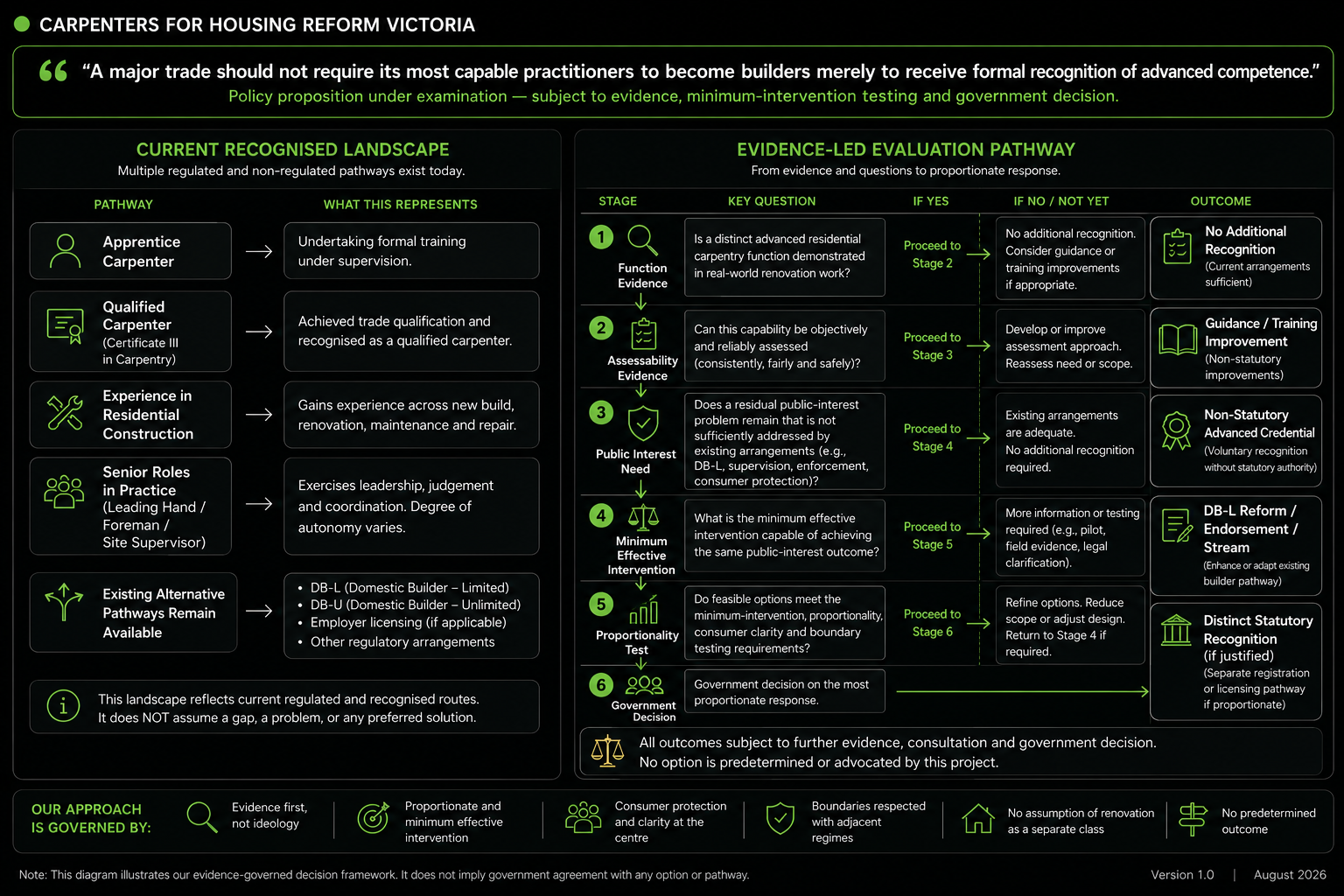
Victoria's current building reforms provide the immediate policy context for considering practitioner capability, scope, accountability and consumer protection. The consultation has not yet settled the final registration or licensing model, scope, assessment settings or contracting permissions.
If the baseline arrangements ultimately adopted leave a materially different additional capability question, government could then compare proportionate mechanisms. A bounded RRC pathway would be one candidate model, not a predetermined result.
The current consultation is considering:
This would support the broader reform objectives of improved consumer protection, clearer accountability, earlier intervention and better building outcomes, regardless of whether any additional recognition is later justified.
Clear baseline scope boundaries help regulators, consumers and practitioners identify responsibility before minor renovation issues become larger disputes.
The reform process can clarify the practical boundary between carpenter work, builder responsibility and other regulated roles.
Any baseline or later recognition model should rely on documentation, written scope limits, permit triggers, engineering triggers and builder handoff rules.
Alongside Victoria’s current work on baseline carpenter registration and licensing, we are examining whether evidence supports additional capability pathways for experienced residential tradespeople.
The Victorian Government’s current trades registration and licensing program is progressing carpentry first, with waterproofing and welding also identified within the funded reform program. This framework will continue to follow that government-led sequence while separately examining whether evidence supports additional advanced or specialist residential trade capability in the future.
The reform initiative now brings together professional recognition, bounded responsibility, risk-based quality assurance and independent evidence.
A developed candidate implementation model if later evidence supports additional recognition for experienced renovation carpenters.
A staged regulatory architecture for future specialist trade recognition — currently investigation only.
A separate risk-based quality-assurance model for high-consequence concealed waterproofing work.
An independent platform for research, consultation and evidence-based reform development.
Read the practical brief for the candidate capability and pilot materials — scope, safeguards, evidence requirements and evaluation framework if later testing is authorised.
Read the engagement brief and decision pathway prepared for government, including the policy question, options and recommended next step.
Builders, engineers, surveyors, insurers, consumers and practitioners are invited to provide feedback on the proposal and pilot concept.
A staged process for clarifying the proposed registration and licensing arrangements, testing whether any additional capability issue remains once those arrangements are clearer, and deciding whether later capability testing or recognition is justified.
Government officials, regulators, industry bodies and implementation partners are welcome to request a 30-minute briefing from Dan Sonsie.